Polymarket has become the default place to trade what happens next. Elections, interest rates, crypto prices, wars, sports and internet drama all sit inside the same marketplace.
Its strength is not difficult to understand. Polymarket lists events people genuinely care about, and its largest markets attract enough activity to make the displayed prices meaningful. The interface also makes buying a YES or NO position feel much simpler than the machinery behind the trade.
The catches appear around the edges. Access depends on where you live. Funding an account may require more steps than a traditional betting or trading platform. Smaller markets can have thin liquidity, and the question displayed in a headline is not always enough to understand how a market will ultimately be resolved.
Polymarket is easy to open and surprisingly easy to misunderstand.
This review looks beyond the clean interface. We examine how trading works, what it really costs, where Polymarket beats its competitors and what you should check before putting money into a market.
Strix Verdict
Score: 8.6/10
Best for: Active prediction market traders
Biggest strength: Market selection and liquidity
Biggest weakness: Regional access and funding complexity
Bottom line: The benchmark for crypto-native prediction markets, but not the simplest option for every user.
How Does Polymarket Work?
Polymarket turns future events into tradable outcomes.
Some markets ask a simple YES-or-NO question. A clear example is whether JD Vance will win the 2028 US Presidential Election.
At the time shown, YES shares traded at around 20¢, implying a market probability of roughly 20%.
That does not mean his actual chance of winning is exactly 20%. It means buyers and sellers were currently willing to trade that outcome at around that price.
Suppose you believe the market is underestimating his chances. You could buy YES shares at roughly 20¢.
Buying YES
At a limit price of 19.8¢, an order for 100 YES shares would cost: 100 × $0.198 = $19.80
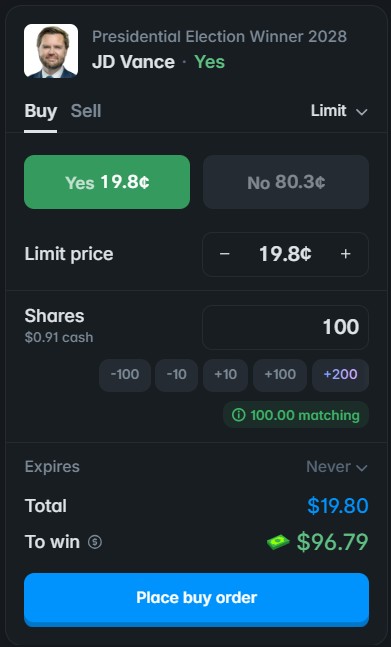
In the example shown, Polymarket displays $96.79 in the “To win” field.
If JD Vance wins the 2028 presidential election and the market resolves to YES, the position would return the amount shown in the trading panel.
Your potential profit would therefore be: $96.79 − $19.80 = $76.99
If JD Vance does not win, the YES shares settle at $0 and you lose the $19.80 paid for the position.
The important number is not only the share price. The trading panel also shows the total cost of the order and the amount you could receive if the outcome wins.
Strix Take
A low-priced share can offer a large potential return because the market considers the outcome unlikely. The bigger upside comes with a higher chance of losing the entire position.
Buying NO
The same market also offers a NO position.
Buying NO means you believe JD Vance will not win the election. You are not choosing another specific candidate. The position wins if anyone else becomes president.
Because the market considers a JD Vance victory relatively unlikely, NO shares cost considerably more than YES shares.
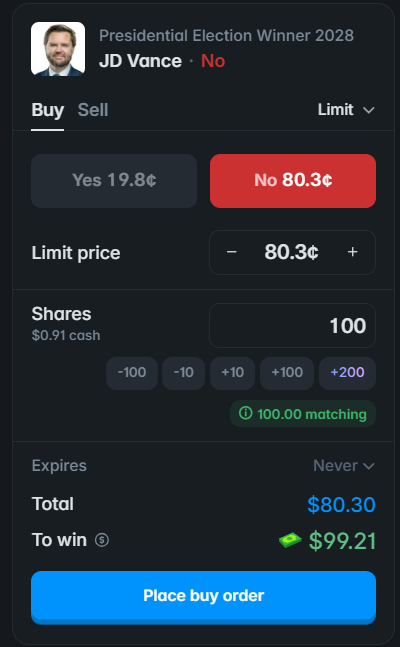
That creates a smaller potential return.
The market is effectively asking you to choose between:
- paying less for an outcome traders consider unlikely
- paying more for an outcome traders consider more likely
Neither position is automatically better. The question is whether you believe the market price accurately reflects the probability.
Before placing the trade, Polymarket shows the order cost and potential return in the trading panel. Those figures should be checked directly rather than estimated from the headline probability alone.
You Can Sell Before the Election
You do not have to wait until November 2028.
Imagine JD Vance performs strongly in polling and his YES price rises from around 20¢ to 35¢.
Your 100 YES shares could then be worth approximately:
100 × $0.35 = $35
Compared with the original $19.80 cost, that would represent an unrealized gain of approximately:
$35 − $19.80 = $15.20
You could sell the shares and take the profit even though the election had not yet happened.
The opposite can also occur.
If the price falls from around 20¢ to 10¢, your 100 shares would be worth approximately $10. You could sell and accept the loss or continue holding in the hope that the price recovers.
This is why Polymarket feels more like trading than fixed-odds betting. Positions can gain or lose value while the event is still developing.
The Displayed Price Is Not Always the Exact Price You Receive
The market may display JD Vance at around 20¢, while the trading panel shows a limit price of 19.8¢.
The large number on the market page is a summary of the current market price. The trading panel shows the price and terms available for your order.
A larger order may also fill across several prices if there are not enough shares available at 19.8¢.
Limit orders introduce another possibility: the order may not fill at all.
You can choose the price you are willing to pay, but another participant must be willing to take the opposite side.
The Catch: The headline price shows the market’s broad view. The order panel determines what your trade actually costs and what it could return.
The Rules Decide the Result
The market title is simple: Will JD Vance win the 2028 US Presidential Election?
The resolution rules are more precise.
The market resolves to YES if JD Vance is declared the winner under the listed resolution sources and conditions. It resolves to NO if another candidate wins.
For the wider 2028 presidential election market, the rules state that the result is confirmed once the Associated Press, Fox News and NBC all call the race for the same candidate.
If all three sources have not called the race for the same person by January 20, 2029, the market resolves based on who is inaugurated.
That means the market is not settled by:
- one network calling the race
- the national popular vote
- an unofficial concession
- the candidate leading on election night
It is settled according to the written resolution conditions.
Before You Trade: The title explains the idea. The rules define what your shares actually represent.
What Is Polymarket Like to Use?
Polymarket is easy to browse. It is not automatically easy to trade well.
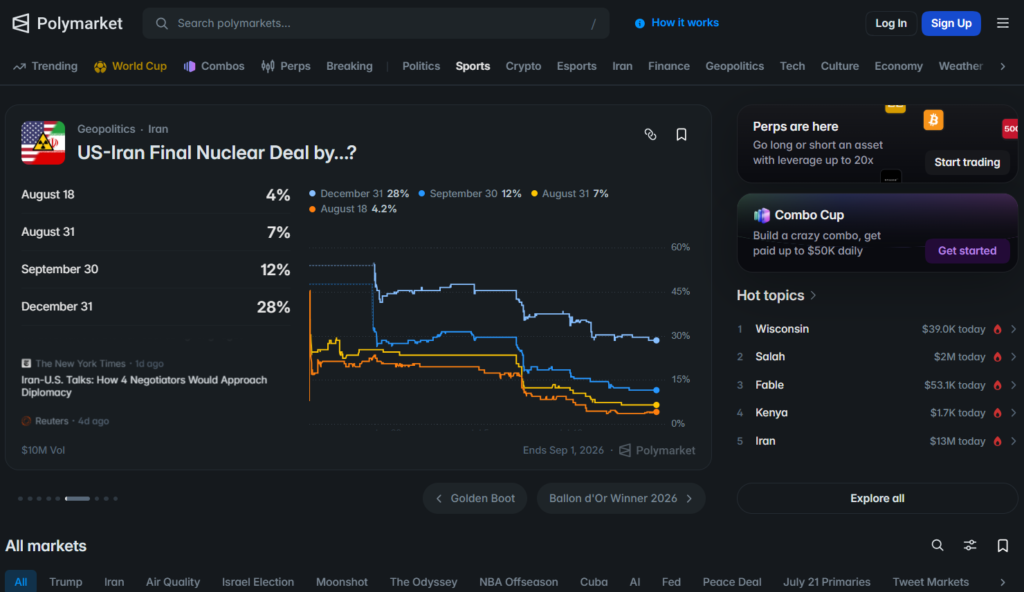
The platform feels more like a live news feed than a traditional trading terminal. Major markets are easy to find, current prices are visible immediately and most of the technical complexity stays out of sight.
That is one of Polymarket’s biggest strengths.
A market page usually shows the question, current price, chart, volume, trading panel and resolution rules in one place. Small trades in active markets can feel almost effortless.
The complexity appears when liquidity is thin, spreads are wide or a limit order does not fill. The headline price may also differ slightly from the price available in the trading panel.
The biggest risk for beginners is false confidence. A clean interface can make a market look simpler than it really is.
The Catch
The interface makes trading easy. It does not make the market easy to understand.
Polymarket also makes open positions feel more like tradable assets than conventional bets. You can monitor their value, sell early or hold until resolution.
That flexibility is useful, but it can encourage unnecessary trading when prices move.
Strix Take
Polymarket is one of the easiest prediction markets to use. The quality of the trade still depends on price, liquidity and the rules behind the market.
Polymarket Markets and Liquidity
Polymarket’s biggest advantage is not the interface. It is the number of markets people actually care about.
The platform covers politics, economics, crypto, sports, technology and major world events. When a story starts moving, there is often already a market for it—or one appears quickly.
This makes Polymarket feel more relevant than many competitors.
The strongest markets can attract large trading volumes and frequent price updates. That usually leads to tighter spreads and makes it easier to enter or exit a position without moving the price too much.
But high volume does not mean every market is liquid.
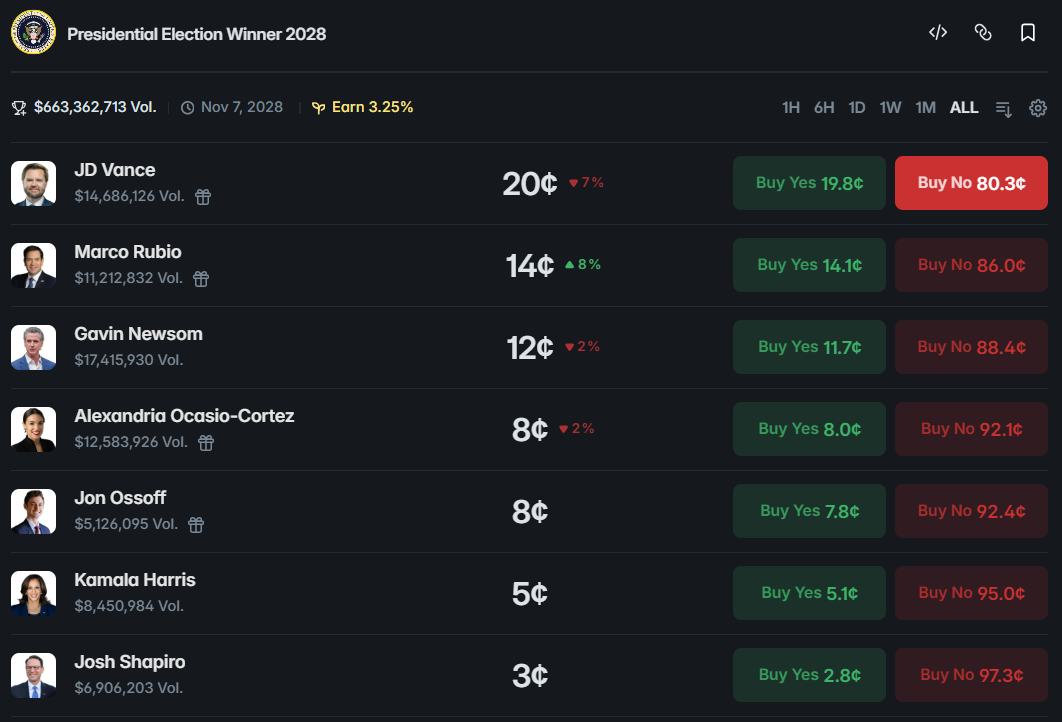
A major event may show hundreds of millions of dollars in total volume while one smaller candidate or niche outcome has very little available at the displayed price.
The Catch
Event volume and market liquidity are not the same thing.
Before placing a meaningful order, check how many shares are actually available near the current price. A large order in a thin market can fill across several price levels and leave you with a worse average entry than expected.
Strix Take
Polymarket is at its best when the market is active, the spread is tight and the rules are clear. Its weaker markets can still look polished, but the trading experience may be very different underneath.
Polymarket Fees
Polymarket does not charge the same fee on every market.
Makers pay no trading fee. Takers pay a fee when they execute against existing liquidity in fee-enabled markets. The fee varies by category and share price, while geopolitical markets remain fee-free.
| Category | Taker Fee Rate | Maker Fee Rate | Maker Rebate |
|---|---|---|---|
| Crypto | 0.07 | 0 | 20% |
| Sports | 0.05 | 0 | 25% |
| Finance | 0.04 | 0 | 25% |
| Politics | 0.04 | 0 | 25% |
| Economics | 0.05 | 0 | 25% |
| Culture | 0.05 | 0 | 25% |
| Weather | 0.05 | 0 | 25% |
| Other / General | 0.05 | 0 | 25% |
| Mentions | 0.04 | 0 | 25% |
| Tech | 0.04 | 0 | 25% |
| Geopolitics | 0 | 0 | — |
Fee rates and rebate percentages may change. Last checked July 2026.
The taker fee rate is not a flat percentage of the full trade value. Polymarket applies a price-dependent fee curve, with the dollar fee generally highest near a 50¢ share price and lower near 0¢ or $1.
The Catch
The formal trading fee is only one part of the cost.
A wide spread or poor execution can cost more than the stated fee rate. Always check the total order cost and potential return shown in the trading panel before confirming the trade.
Strix Take
Polymarket’s fees are transparent once you understand the structure. The table tells you which categories charge taker fees. The order panel tells you what your specific trade will actually cost.
Polymarket Deposits and Withdrawals
Polymarket supports both crypto and cash deposits.
The crypto option is built around a bridge that accepts funds from several blockchains and converts them for use on the platform.
Supported crypto networks
| Network | Min. deposit | Example supported tokens |
|---|---|---|
| Ethereum | $7 | ETH, USDC, USDT, WBTC, DAI, LINK, UNI, AAVE |
| Polygon | $2 | POL, USDC, USDT, DAI, WETH, SAND |
| Arbitrum | $2 | ETH, ARB, USDC, USDT, DAI, WBTC, USDe |
| Base | $2 | ETH, USDC, USDT, DAI, cbBTC, AERO, USDS |
| Optimism | $2 | ETH, OP, USDC, USDT, DAI, USDe |
| BNB Smart Chain | $2 | BNB, USDC, USDT, DAI, ETH, BTCB, BUSD |
| Solana | $2 | SOL, USDC, USDT, USDe, TRUMP |
| Bitcoin | $9 | BTC |
| Tron | $9 | USDT |
| HyperEVM | $2 | HYPE, USDC, USDe, stHYPE, UBTC, UETH |
| Abstract | $2 | ETH, USDC, USDT |
| Monad | $2 | MON, USDC, USDT |
| Ethereal | $2 | USDe, WUSDe |
| Katana | $2 | AUSD |
| Lighter | $2 | USDC |
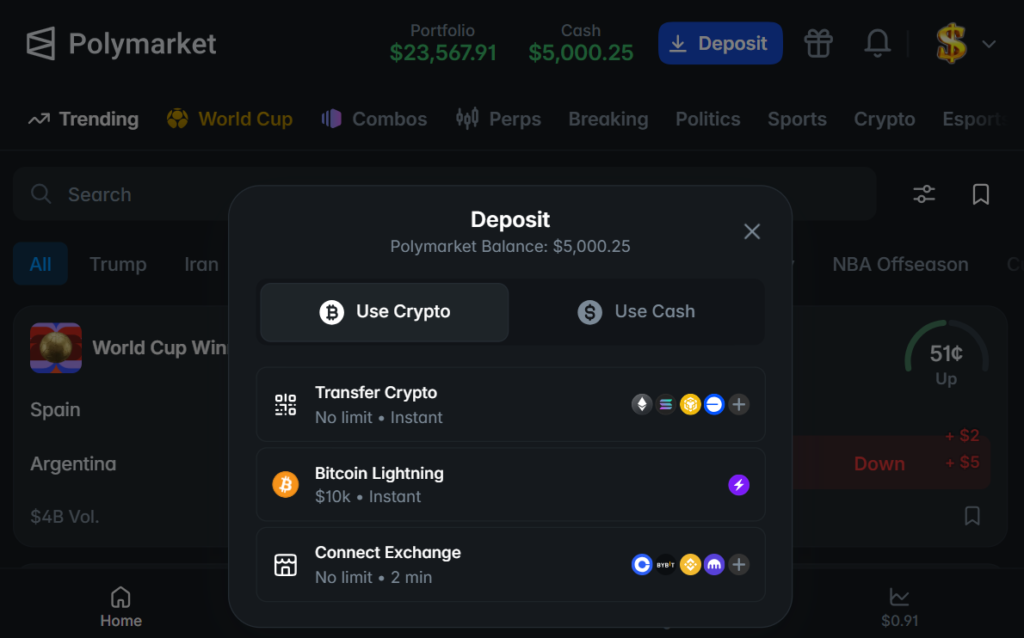
The minimum is low on most supported networks. Polygon, Arbitrum, Base, Optimism, BNB Smart Chain and Solana all start at $2, while Ethereum requires at least $7 and Bitcoin and Tron require $9.
The important detail is not only the token. The network must also match.
Sending USDC through Base is not the same as sending USDC through Ethereum. The token may have the same name, but the transfer route is different.
The Catch
A supported token can still be sent through the wrong network.
Always copy the deposit address from Polymarket, select the exact matching chain and send a small test amount first. Crypto transfers are difficult or impossible to reverse once confirmed.
Cash deposit options
Polymarket also offers cash funding methods.
Available options shown on the platform include:
| Method | Displayed limit | Speed |
|---|---|---|
| Card | Up to $114,000 | Instant |
| Apple Pay | Up to $114,000 | Instant |
| Cash App | Up to $10,000 | Instant |
| Google Pay | Up to $114,000 | Instant |
| Bank transfer | Varies | Varies |
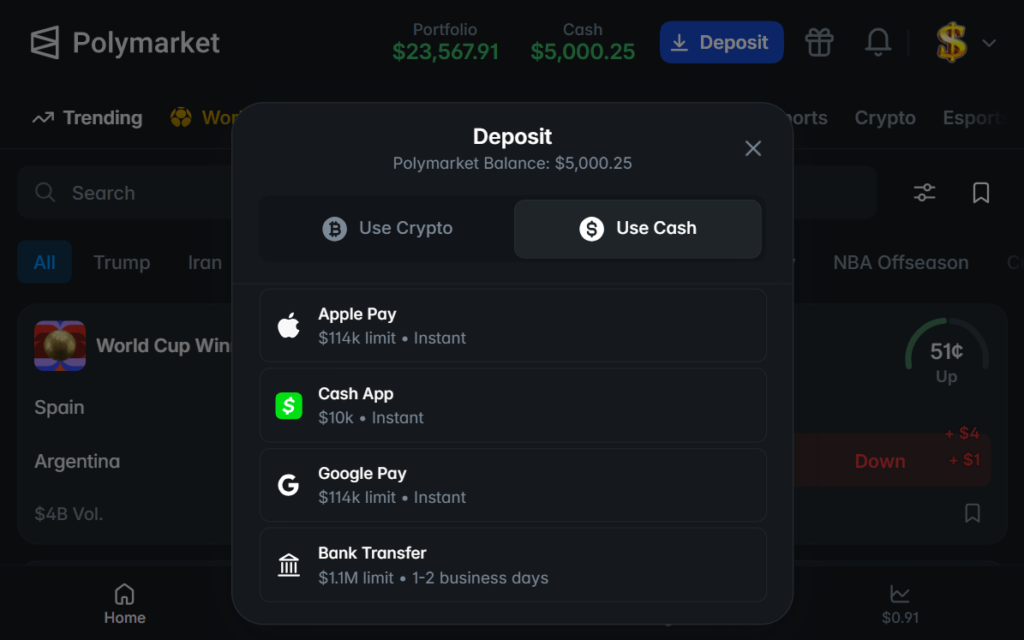
This makes Polymarket more accessible than a crypto-only platform.
A user does not necessarily need to buy crypto on an exchange and transfer it manually. Card and mobile-wallet funding can remove several steps from the process.
Availability, limits and verification requirements may still depend on the user’s location and the payment provider handling the transaction.
Withdrawals
Crypto withdrawals require a destination address and the correct network.
Before confirming, check:
- the wallet address
- the selected blockchain
- the token
- the withdrawal amount
- any displayed network or provider costs
For cash users, the available withdrawal route may depend on how the account was funded and which options are supported in the user’s region.
Strix Take
Polymarket is no longer difficult to fund simply because it uses crypto infrastructure.
Cash methods make the first deposit much easier. Crypto remains the more flexible option, but it also leaves less room for mistakes.
Is Polymarket Safe?
Polymarket is a legitimate prediction market platform, but “safe” needs to be separated into several different questions.
The platform is non-custodial. Funds are held through a wallet controlled by the user rather than in a conventional account balance fully controlled by Polymarket. Trades are matched through an order book and settled using smart contracts. Polymarket says its current exchange contracts are open source and have been audited by Cantina and Quantstamp.
That reduces some platform-custody risk. It does not remove trading risk, account-security risk or the possibility of a disputed market result.
| Risk | What it means |
|---|---|
| Account security | Anyone with access to your login code or private key may be able to control your funds |
| Trading risk | A position can settle at $0 if your prediction is wrong |
| Liquidity risk | You may not be able to exit at the price shown |
| Smart-contract risk | Audits reduce risk but do not guarantee that software is flawless |
| Resolution risk | A market may resolve differently from a casual reading of its title |
| Regulatory risk | Availability and legal treatment depend on location |
Account Security
Users can sign in with email, Google or a connected crypto wallet. Polymarket warns users never to share email login codes or private keys. If another person gains access to them, support may not be able to recover the funds.
The basic precautions are straightforward:
- use a secure email account
- never share login codes
- never share a private key or recovery phrase
- verify the website address before signing in
- ignore direct messages claiming to be support
Market Resolution
Polymarket markets resolve according to their written rules, not simply the most obvious interpretation of the headline.
A result is proposed through the UMA Optimistic Oracle and initially enters a two-hour challenge period. If disputed, the process can move through debate and voting before the outcome becomes final.
This system creates a transparent dispute process, but it also means some markets can take longer to settle when the result is unclear or contested.
The Catch
Non-custodial does not mean risk-free.
It means Polymarket does not control your funds in the same way as a traditional centralized operator. More responsibility therefore sits with the user. A compromised email account, shared login code or incorrect crypto transfer can still cause a permanent loss.
Strix Take
Polymarket appears to use serious security infrastructure, audited contracts and a defined resolution process. Its biggest everyday risks are more ordinary: choosing the wrong market, ignoring the rules, overpaying in a thin order book or failing to secure your account.
Polymarket Pros and Cons
Polymarket’s strengths are easy to see. Its weaknesses matter more once real money is involved.
| Pros | Cons |
|---|---|
| Large selection of relevant markets | Availability depends on location |
| Strong liquidity on major events | Smaller markets can be thin |
| Clean and easy-to-use interface | The simple design can hide complexity |
| Positions can be sold before resolution | Resolution rules require careful reading |
| Supports both crypto and cash deposits | Payment options vary by region |
| Transparent market prices and charts | Displayed prices are not always the exact execution price |
| Active markets react quickly to news | Fast-moving prices can encourage overtrading |
Strix Take
Polymarket is strongest when the market is active, the spread is tight and the resolution rules are clear.
Its biggest weakness is not one specific feature. It is the gap between how simple the platform looks and how much attention a good trade still requires.
For experienced users, that gap is manageable.
For beginners, it is where most mistakes happen.
How Polymarket Compares
Polymarket is strongest in market variety, cultural relevance and crypto-native trading.
Kalshi offers a more regulated US-focused structure. PredictIt is narrower and heavily centered on politics. Manifold is more community-driven and often uses play money rather than real-money trading.
For a full breakdown, read our comparison:
Polymarket vs Kalshi: Which Prediction Market Is Better?
Who Should Use Polymarket?
Polymarket makes the most sense for users who want more than a simple fixed-odds bet.
It is a strong fit for people who:
- follow politics, economics, crypto or major world events closely
- want to trade changing probabilities rather than wait for a final result
- understand that market prices can move quickly
- are willing to read resolution rules before buying
- are comfortable checking liquidity, spreads and order details
- want access to both crypto and cash deposit options
The platform is particularly useful for users who already think in probabilities.
If you believe an outcome has a 35% chance of happening while the market prices it at 20¢, Polymarket gives you a direct way to trade that disagreement.
It is less suitable for users who:
- want a completely passive sportsbook-style experience
- assume the displayed percentage is an objective forecast
- do not want to review rules or order details
- are uncomfortable with changing prices
- expect every market to have deep liquidity
- live in a location where access is restricted
The Catch
Polymarket is beginner-friendly at the interface level, but not necessarily at the decision-making level.
Strix Take
Polymarket is best for curious, informed users who want to form their own view of an event and trade against the market price. It is a weaker fit for anyone looking for guaranteed simplicity.
Final Verdict
Polymarket has become the benchmark for prediction markets because it combines relevant markets, strong activity and a clean trading experience better than most competitors.
Its largest markets are fast, liquid and genuinely useful as a live measure of what traders believe will happen next. The platform also makes it easy to enter a position, monitor its value and sell before the final result.
The weaknesses appear beneath that simplicity.
Prices are not objective probabilities. Smaller markets can be thin. Resolution rules matter more than headlines. Fees, spreads and execution can all affect the return shown on screen.
Polymarket is therefore easy to use, but not always easy to use well.
Strix Verdict
Best for: Users who want to trade politics, economics, crypto and major world events
Biggest strength: Market selection and activity
Biggest weakness: The interface can make complex trades look deceptively simple
Overall verdict: Polymarket is the strongest all-round prediction market for informed users, but it rewards attention more than confidence.
For users willing to check the rules, understand the price and review the order before buying, Polymarket is difficult to beat.
Frequently Asked Questions
Is Polymarket safe?
Polymarket uses non-custodial wallets, which means users retain control of their funds rather than depositing them into a conventional platform-controlled balance. That reduces some custody risk, but users remain responsible for protecting their login credentials and private keys. Trading, liquidity and market-resolution risks still remain.
Does Polymarket charge fees?
Yes, some markets charge taker fees. Makers are not charged trading fees, while taker fees vary by market category and share price. Geopolitical markets are currently listed as fee-free. Always check the order panel because the total cost depends on the specific market and trade.
Can you sell a Polymarket position early?
Yes. Shares can be sold before the market resolves using either a market order or a limit order. A limit order only executes when another trader is willing to buy at the price you set.
Can you lose all your money on Polymarket?
Yes. If you buy YES shares and the market resolves to NO, those shares become worthless. The same applies in reverse. You can also lose money by selling a position after its price falls.
What does a price of 20¢ mean on Polymarket?
A price of 20¢ suggests that the market currently assigns the outcome roughly a 20% probability. The price is determined by supply and demand between traders, not set directly by Polymarket.
Does Polymarket accept cash deposits?
Polymarket offers cash funding options in addition to crypto, although the available methods, limits and verification requirements can depend on the user’s location and payment provider. The platform also supports crypto deposits across multiple networks.
What currency does Polymarket use?
Polymarket’s markets are collateralized in dollar-backed digital assets. Its current help documentation refers to pUSD, an ERC-20 collateral token on Polygon backed by USDC.
Is Polymarket a sportsbook?
Not exactly. Polymarket is a peer-to-peer prediction market. Users trade with other participants rather than betting directly against a bookmaker or “house.” Prices move according to supply and demand.
How does Polymarket decide the winner?
Each market has written resolution rules specifying the source, deadline and treatment of edge cases. The market title describes the question, but the rules determine how it settles. Winning shares pay $1, while losing shares become worthless.
Can anyone use Polymarket?
No. Trading is restricted in certain countries and regions, and Polymarket prohibits using a VPN to bypass those restrictions. Users should check the current geographic-restrictions page before depositing or trading.
Is Polymarket gambling or trading?
It has elements of both. Users risk money on uncertain future outcomes, but positions are traded through an order book and can be sold before resolution. The exact legal classification depends on the jurisdiction. Polymarket itself describes the product as a peer-to-peer prediction market rather than a traditional sportsbook.
Do you need to hold a position until the event ends?
No. You can hold until resolution, sell early to lock in a profit or cut a loss, or leave a limit order waiting for your chosen price. Liquidity is required for an early sale to execute.
Damit ist der eigentliche Artikel vollständig. Als Nächstes fehlen nur noch Meta Title, Meta Description, Excerpt und die interne Verlinkung.